Gel formation in coaxial flow
Modelling hydrogel formation in coaxial flows for Schlumberger
Supervisors
Prof. Andreas Muench, Asst. Prof. Sourav Mondal, Harvey Williams (Schlumberger Gould Research)
Project Overview
This project was part of a three month mini-project I worked on for the Industrially Focussed Mathematical Modelling (InFoMM) Centre for Doctoral Training. For these three months we collaborated with Schlumberger Gould Research in Cambridge to model a novel manufacturing process they were interested in.
Schlumberger was interested in investigating a process for manufacturing small, hollow gel-sleeves (see Fig. 1). Through this process, gel “sleeves” are made by injecting a solution containing one of the reactants (say Reactant A) into the center of a flowing solution containing another reactant (say Reactant B). The resulting flow environment is a coaxial flow, where an annular flow encloses an axisymmetric flow (see Fig. 2). The diffusion of reactants across the interface allows a gelation reaction to take place, resulting in an evolving gel-layer between the co-flowing fluids.
We modelled this system to better understand how the apparatus configuration determines the final properties of the gel-sleeves. By considering a number of interesting limits we were able to obtain good, leading-order predictions for some useful properties of the gel (e.g. the gel-sleeve diameter, and the rate of gel-mass increase along the axis of flow).
We also used COMSOL, proprietary multi-physics software, to perform full numerical simluations to (i) verify our analytic approach and (ii) obtain greater insight into the flow regimes.
Further Reading
- A paper we published on this work can be found HERE
Technical Details
- ComSol for full numerical simulation
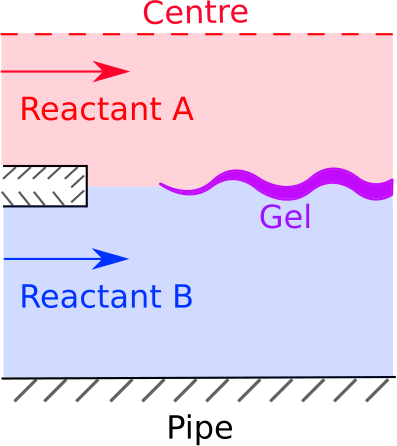
Fig.1 A schematic of a device for manufacturing hollow gel-sleeves. In this case, a solution of reactant A (red) is injected into a solution of reactant B (blue). A reaction takes place where the solutions meet, producing a gel (purple).
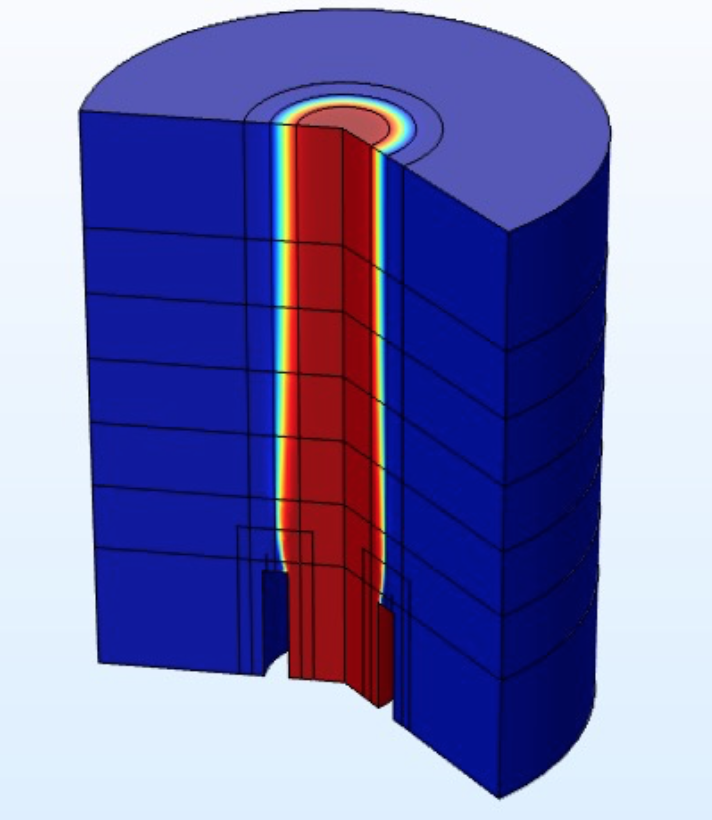
Fig.2 Results of a similation performed using COMSOL illustrating the annular flow of a solution of reactant b (blue) enclosing an evolving hollow gel-sleeve (transition) and an axisymmetric solution of reactant A (red)